Bone Tunnel Stress in AC Joint Reconstruction
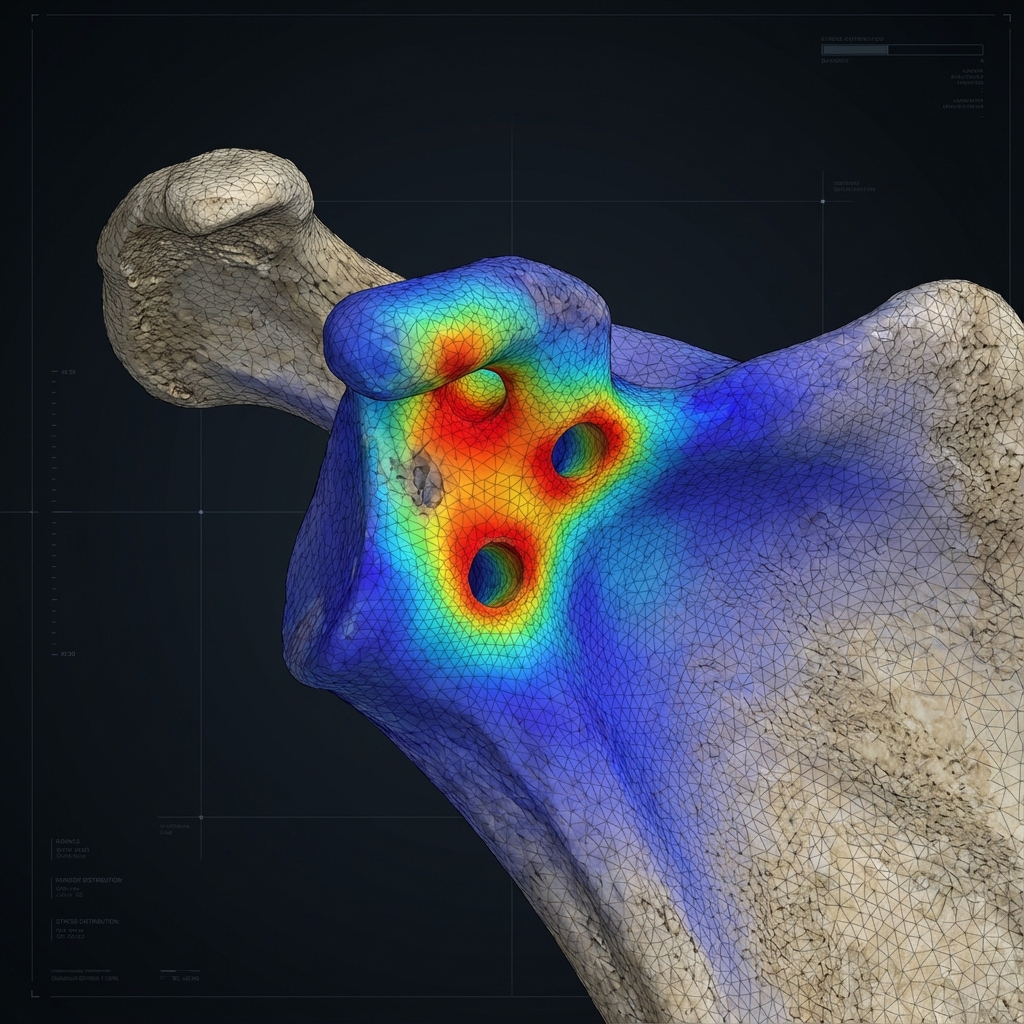
Bone Tunnel Placement Influences Shear Stresses at the Coracoid Process after Coracoclavicular Ligament Reconstruction
Project Overview
This study investigated how bone tunnel placement during coracoclavicular (CC) ligament reconstruction affects shear stresses on the coracoid process. Using a 3D finite element (FE) model combined with a radiological analysis of patient data, the project evaluated different bone tunnel configurations to identify safer surgical techniques that reduce the risk of coracoid fractures.
Problem & Motivation
Arthroscopically assisted AC joint reconstructions often involve drilling tunnels in the clavicle and coracoid. However, stress fractures at the coracoid are a known complication, leading to poor clinical outcomes. Cadaver studies offer limited insights due to variable bone quality, so there is a need for computational and clinical analyses to identify optimal bone tunnel configurations that minimize mechanical stress.
Key Contributions
- Built a 3D finite element model of the AC joint using CT imaging and virtual bone tunnels.
- Tested six different tunnel configurations for clavicle–coracoid reconstruction.
- Conducted a radiological review of 40 patient cases to validate tunnel placement in real surgeries.
- Identified that a proximal coracoid tunnel combined with a lateral clavicle tunnel minimized shear stresses.
- Showed that certain configurations increased stress by up to 23%, raising fracture risk.
Technical Highlights
- Tools & Platforms: CT-based 3D modeling, 3D Slicer, GiD pre/post-processing, Kratos FE solver.
- Methods: Finite Element Analysis (Von Mises stress evaluation), radiological measurement of clavicle drill holes, statistical analysis with SPSS.
- Model Details: 420,793 tetrahedral finite elements, applied surface loading, Dirichlet boundary conditions.
- Validation: Compared FE predictions with radiological evidence from post-surgical X-rays of AC joint reconstructions.
Results & Impact
The study demonstrated that bone tunnel placement strongly influences stress distribution at the coracoid. A lateral traction direction with a proximal tunnel significantly lowered stresses, while medial or distal placements increased fracture risk.
Publication Details
Journal: Archives of Orthopaedic and Trauma Surgery
Year: 2023
DOI: 10.1007/s00402-022-04382-9